
Fuel monitoring on railway track machines
How the track division of Latvian Railways cut fuel consumption on its track machines by 20% in four months with DFM flow meters and on-board terminals.
The track division of Latvian Railways
Latvijas dzelzceļš is the national railway company of Latvia, founded in 1919 and re-established in 1994. Its track division, Ceļu distance, continuously monitors the condition of tracks, switches and engineering structures, checks them against safety requirements and sets permitted train speeds.
- 17+ million passengers per year
- 55+ million tons of cargo per year
- 2,000+ km of railway lines
- 40,000+ tons of diesel fuel per year
Safety-critical work, rising fuel and maintenance costs
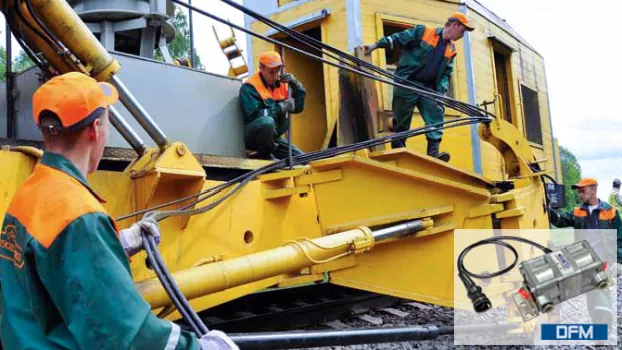
The division’s rolling stock is mostly track machines — DKGY handcars, WM-15S12 track machines, BDS-200 ballast distributors, Dynamic 09-3X and Duomatic 08-32 tampers, USP 2005-SW ballast planers and TEM2 shunting locomotives — powered by Deutz, Caterpillar and JaMS diesels of 150–400 hp and 6–14 L.
The machines handle urgent, safety-critical work in any weather and at any hour, often on non-standard working days. That duty cycle drives up fuel consumption and maintenance. Management decided to equip the track machines with a system that measures fuel consumption and operating time in real time and turns it into reports.
DFM flow meters with an on-board terminal
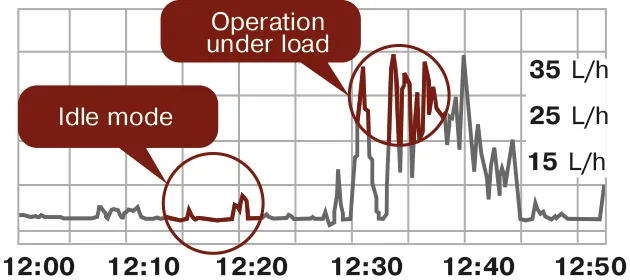
DFM fuel flow meters were mounted in each engine’s fuel supply line — single-chamber DFM 100AK / 500AK or differential DFM 250D / 500D, depending on the engine and its consumption. Each meter measures actual consumption, counts engine hours in idle, optimal and overload modes, and registers tampering attempts.
A CKPT 31 terminal in the cab stores the data in non-volatile memory and displays it to the operator. Data is then transferred to a PC via Bluetooth, where software builds fuel and engine-hour reports as tables or charts.
After four months of operation, fuel consumption on the track machines was down 20%. Reports on fuel and engine time showed management where machines could be used more efficiently — machine performance rose by 10%. The meters ran accurately and trouble-free in harsh conditions, and their tamper protection closed off fuel manipulation.
Task → Solution → Result
No per-engine fuel data
Track machines work around the clock in any weather; fuel and maintenance costs were rising with no measurement per engine.
DFM flow meters + terminal
Single-chamber or differential DFM meters on every engine, with an on-board terminal logging fuel and engine hours by mode.
−20% fuel, +10% performance
Within four months fuel consumption fell 20% and machine performance rose 10%.
In our opinion, and taking in account operation experience, fuel consumption monitoring system, based on DFM fuel flow meters and offline terminal CKPT 31 is the most reliable and accurate solution on the market.
Vladlen Maakedons · Latvijas dzelzceļš Ceļu distance
Want product info and guidance from our experts?
Tell us about your fleet and we'll recommend the right measurement setup.